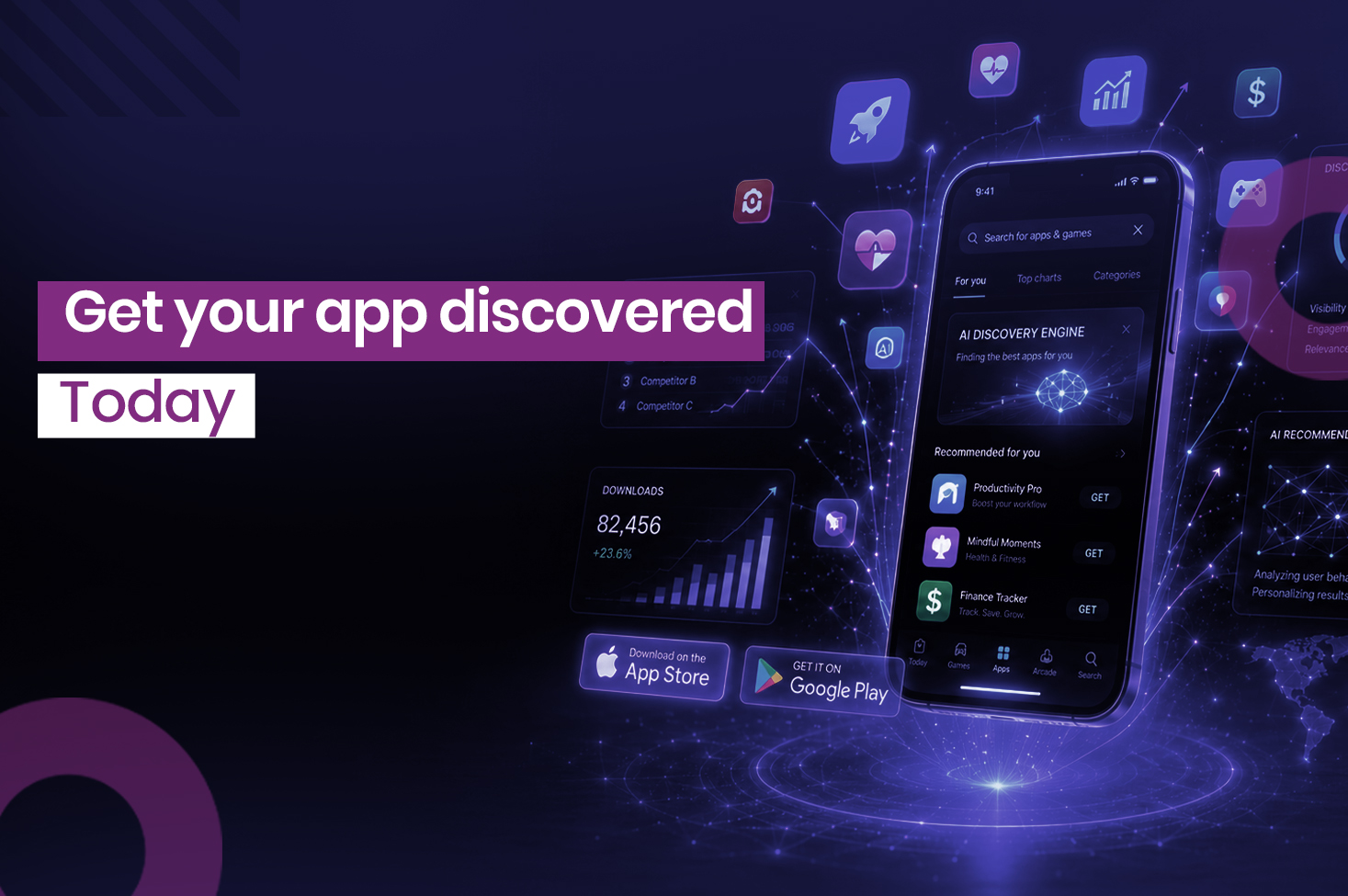
In 2026, nearly 4,700 new apps were released across Google Play and the Apple App Store every day. Google Play sees around 2,137 new apps daily, while the Apple App Store adds about 2,629. That means visibility is no longer won by launch alone. Users scroll fast, judge faster, and often decide within seconds. Your app title, icon, screenshots, ratings, and description can determine whether they tap, download, or move on.
This is where App Store Optimization (ASO) comes into play. ASO is the process of refining your app’s store presence to improve search rankings, attract high-intent users, and increase organic downloads without relying solely on paid campaigns. From optimizing keywords and metadata to enhancing screenshots and preview videos, ASO impacts both discovery and conversion.
Let’s look at the core strategies and best practices that make ASO a must-have for app success.
10-point ASO Health Check for Your App Store Page
Before diving into optimization strategies, it’s essential to assess your app’s current ASO health. Conducting a quick audit helps identify gaps in visibility, conversion, and keyword coverage. Here are ten critical checkpoints:
- App Title: Does it include your primary keyword while remaining brand-friendly and clear?
- Subtitle/Short Description: Does it quickly convey the app’s core value proposition?
- Keyword Field (iOS only): Are all terms relevant, unique, and non-repetitive?
- Long Description: Is it optimized with natural keyword placement and clear messaging (Google Play)?
- Screenshots: Do the first three screenshots showcase key features and benefits?
- App Icon: Does it stand out among competitors in search results?
- Preview Video: Does it communicate the app experience clearly, even without sound?
- Ratings and Reviews: Are recent reviews positive, and is your average rating strong?
- Retention Metrics: Do users continue to open the app after installation, minimizing uninstalls?
- Localization: Are titles, descriptions, and visuals adapted for international markets?
Completing this audit sets the stage for targeted improvements in both metadata and performance-driven ASO strategies.
The Two Pillars of ASO: On-Metadata vs. Off-Metadata
Successful ASO depends on both metadata you control and performance factors influenced by users. Think of it like web SEO: on-page tweaks improve relevance, while off-page signals show authority and engagement. For apps, these pillars work together to drive visibility, conversions, and long-term ranking strength
| On-Metadata Optimization (You Control) | Off-Metadata Optimization (User-Driven) |
| App Title and Subtitle: Top-weighted elements for keyword relevance. Include primary, high-traffic terms naturally. | Download Volume and Velocity: Total installs and how quickly they happen signal app popularity. |
| Keyword Field (iOS only): Hidden 100-character field for comma-separated terms. Avoid repetition across the title or subtitle. | Retention and Usage: Frequent, ongoing engagement and low uninstall rates improve ranking and signal value. |
| App Description: Indexed heavily by Google Play for keywords; Apple uses it mainly to convert users. Clear, benefit-driven copy boosts click-throughs. | Ratings and Reviews: Volume, frequency, and positive sentiment indicate app quality and affect ranking. |
| Visual Assets: Icons, screenshots, and preview videos don’t directly impact search rankings but significantly influence conversion rates. | Crash Rates and Technical Health: Stability, speed, and performance metrics influence store visibility and user trust. |
Key Takeaway: On-metadata improvements bring users to your app, while off-metadata factors ensure they stay. Optimizing both simultaneously creates a compounding effect: better visibility leads to more downloads, and higher-quality engagement supports improved rankings over time.
Critical Reasons Your Mobile Business Cannot Ignore ASO
Relying solely on paid campaigns to acquire app users is costly and unsustainable. ASO establishes a long-term growth engine that continuously drives organic installs, improves conversion, and reduces acquisition costs. Here’s why ASO is indispensable for mobile businesses:
- Slashing Your User Acquisition Costs
Paid campaigns such as Meta App Install ads, Google App campaigns, or Apple Search Ads stop driving traffic the instant the budget runs out. ASO, on the other hand, fuels continuous, baseline organic downloads 24/7. Optimizing keywords, metadata, and creatives ensures that high-intent users discover your app without paying per click, lowering dependency on paid marketing.
- Capturing High-intent Searching Users
App store search users are actively looking to solve a problem. When someone types “budget tracker”, “flight scanner”, or “photo editor”, they already intend to install a solution. Ranking for the right keywords puts your app in front of these high-conversion, ready-to-install users, increasing both quantity and quality of downloads.
- Maximizing Global App Expansion and Revenue
Localization amplifies ASO’s impact across international markets. Translating titles, descriptions, screenshots, and preview videos allows your app to naturally capture new regions without relaunching separate builds. This strategy broadens your reach, improves global visibility, and boosts revenue opportunities in markets where users prefer apps in their local language.
- Turning Ad Impressions Into Actual Installs
Every ad click funnels users to your app store page. Even the most compelling paid campaigns fail if your store listing does not convert. Optimized screenshots, descriptions, and creative assets ensure that paid traffic converts into installs. Without ASO, high ad spend may generate impressions but result in lost opportunities at the final conversion point.
Key Technical Differences Between iOS ASO and Android ASO
You cannot use the exact same optimization strategy for both platforms. Apple and Google Play have distinct indexing behaviors, metadata rules, and testing tools, so understanding platform-specific nuances is crucial for effective ASO.
- The Apple App Store Framework
Apple uses a structured keyword system. The main ranking factors include the app title, subtitle, and the hidden 100-character keyword field. Repeating keywords across these fields wastes space; each field should expand your app’s coverage without duplication.
Key points for iOS ASO:
- The long description is not indexed for search; it should focus on conversion, clarity, and trust.
- Product Page Optimization (PPO) allows developers to test up to three variants of icons, screenshots, and app preview videos. Teams can control traffic allocation to each variant and measure impact using App Analytics.
- PPO only runs on iOS 15 and later, so results don’t capture the entire user base. This limitation is important for agencies managing client apps.
- Updating metadata or creative assets often requires submitting a new app version for review by Apple’s QA team, which can delay changes.
- The Google Play Store Framework
Google Play functions more like a traditional search engine, crawling the short description (80 characters) and long description (up to 4,000 characters) for keyword relevance, context, and semantic meaning.
Key points for Android ASO:
- Keyword repetition across the short and long descriptions is necessary for ranking, but it must remain natural and readable.
- Google offers Store Listing Experiments to A/B test icons, screenshots, feature graphics, and descriptions. Teams can measure conversion differences without affecting rankings.
- Metadata updates can be pushed live immediately without requiring a full app release, allowing for rapid iteration and seasonal updates.
Key Takeaways for Cross-platform ASO
Apple relies on structured fields, keyword limits, and PPO; Google relies on textual indexing and live updates. Both platforms require high-quality visuals and conversion-focused descriptions, but their ranking algorithms respond differently to keywords and metadata.
Agencies and app owners must treat iOS and Android ASO as complementary but distinct strategies, not a one-size-fits-all approach.
How ASO Connects Visibility, Conversion, and Retention
ASO isn’t just about ranking higher in search results; it also ensures that users who discover your app actually install it and stay engaged over time. Effective ASO creates a compounding growth loop across visibility, conversion, and retention.
- Visibility: Optimized keywords and metadata increase your app’s discoverability in search and browse channels. High-ranking apps appear in top charts, category pages, and recommendations.
- Conversion: Strong visual assets, icons, screenshots, and preview videos paired with persuasive, benefit-driven descriptions encourage users to download your app once they find it.
- Retention: Apps that deliver value and maintain performance keep users engaged. High retention and low uninstall rates signal quality to app stores, improving long-term rankings.
When these three elements work together, your app benefits from sustained organic growth. Better rankings lead to more impressions, higher-quality installs improve retention, and strong retention further boosts visibility a self-reinforcing cycle that compounds over time.
Build Long-term App Growth with Strong ASO
ASO is no longer optional; it’s essential for mobile success. By combining strategically optimized keywords, persuasive visuals, and data-driven creative assets with user-driven performance signals like downloads, ratings, and retention, ASO ensures your app is both discoverable and highly engaging.
Liqvd Asia helps businesses put a structured ASO strategy in place, so teams are not stuck guessing or constantly refreshing creatives. Instead, they get a clearer, more predictable workflow built around real results. By leveraging ASO in digital marketing with structured workflows and creative optimization, brands like Liqvd Asia help apps achieve sustainable growth and long-term success
When approached consistently, ASO reduces dependence on paid campaigns, captures high-intent users, supports global expansion, and positions your app for lasting success.
FAQs
- How long does it typically take to see ranking changes after updating ASO metadata?
Ranking improvements can start within a few days, but meaningful changes usually take two to four weeks. The timeline depends on factors like keyword competition, download velocity, conversion rates, and review activity. Consistent monitoring is key to measuring real impact.
- Can you optimize your app store page without changing your app’s core software code?
Yes. Many ASO updates involve metadata, visuals, and creative assets rather than the app’s underlying code. Titles, descriptions, screenshots, preview videos, and localized content can all be updated independently to improve visibility and conversions.
- What is the difference between ASO and traditional web SEO?
ASO focuses on improving app visibility, ranking, and conversion within app stores, while web SEO targets search engines like Google. Both use keywords, relevance, and authority signals, but ASO also factors in downloads, retention, uninstall rates, and store-specific visual assets.
- How frequently should you update your app’s keywords and screenshots to stay competitive?
App store performance evolves quickly. Teams should review keywords monthly and update screenshots, icons, or descriptions whenever performance drops, competitors shift, or new features are released. Seasonal campaigns and international launches may also require refreshed creative assets.
- Why is an app’s uninstall rate factored into its overall search rankings?
High uninstall rates indicate low user satisfaction. App stores treat frequent uninstall behavior as a negative quality signal, potentially lowering visibility. Optimizing onboarding, metadata accuracy, and app performance helps reduce uninstall rates and maintain strong rankings.